 teddywrites
Serial · Part 3 · Ongoing
All the Time Between Us
Someone wanted to show a shortcut and a bookstore.
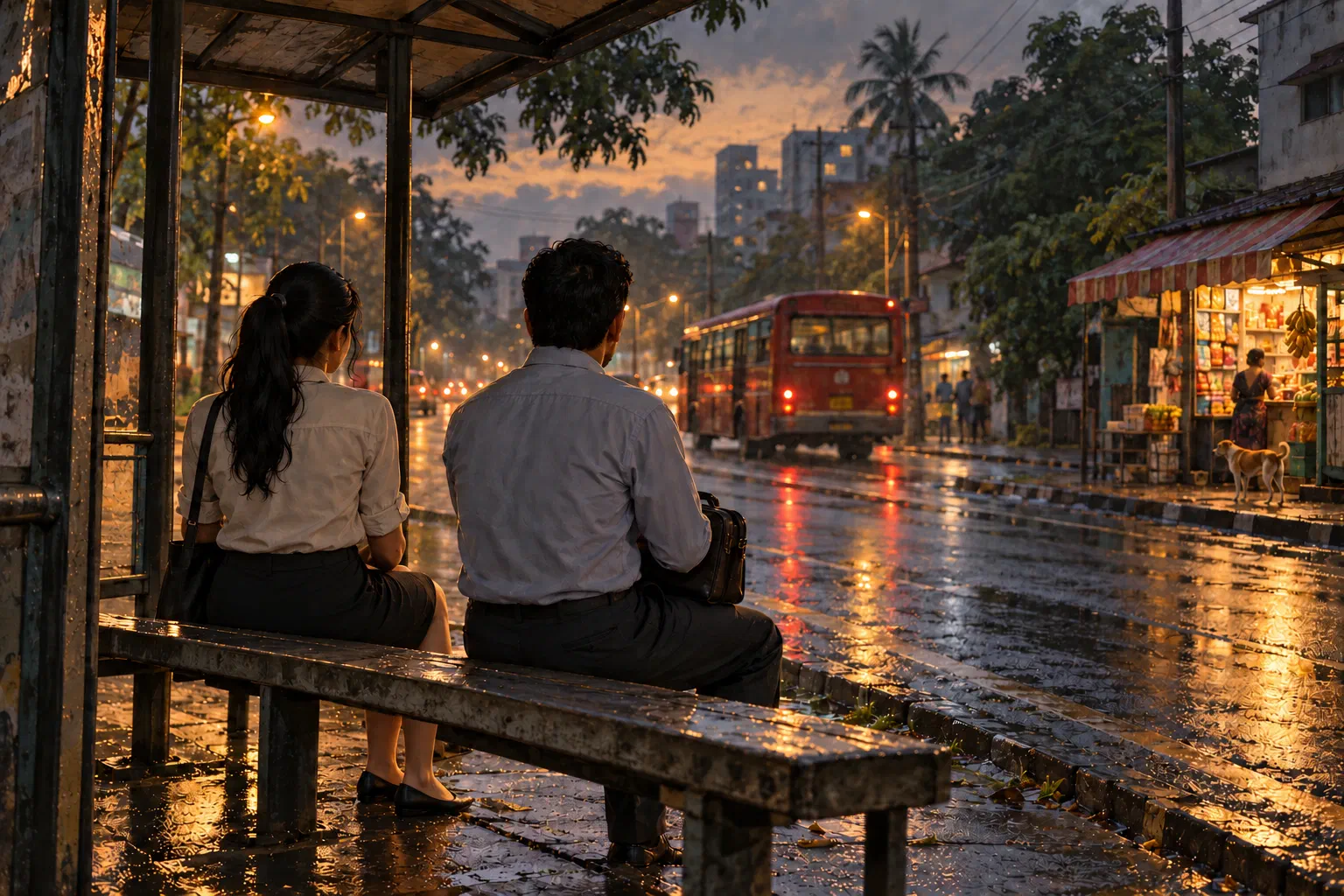
“On Friday I found Imaya halfway up a ladder.
At least, that was how it looked from the corner. When I got closer I saw that the ladder was leaning against the bus shelter and she was standing on the low wall behind it, trying to read a notice over a man’s shoulder.
“They’ve moved our stop,” she said.
The word “our” pleased me enough that I missed the rest.
“Sorry. Where?”
“To the other side of the junction. They’re digging up the road on Monday.”
“Then why are they moving it today?”
“You could ask him.”
The man on the ladder was fastening the notice with a piece of wire held between his teeth. I decided to let him get on with it.
Imaya stepped down from the wall. “Come on. I know a shortcut.”
We turned into the lane beside the pharmacy. After three years of passing it twice a day, I had somehow assumed it ended at the bins. Beyond them the lane widened. There was a tailor’s shop, a house with a green gate, and a little girl sitting on the doorstep in one sock while her mother searched through a pile of shoes.
“Did you come this way to work?” I asked.
“Sometimes. There used to be a bookshop down here.”
“Did they sell anything I’d have read?”
“What do you read?”
It occurred to me that I’d walked straight into that.
“Quite a few things.”
“Name one.”
“I’m thinking.”
“Take your time.”
By the green gate I’d remembered a detective novel my sister had lent me. I could picture the cover, a yellow house with one upstairs window lit, but neither the title nor the author came to mind.
“There’s a murder in it,” I offered.
“That should narrow it down.”
I asked what she used to buy.
“Mostly I went in to read the last pages.”
“Before you bought the book?”
“Sometimes instead of buying it.”
“Doesn’t that spoil it?”
“If I’ve stood there for ten minutes reading about a woman who’s lost her son, I’d like to know if she finds him before I go back to work.”
“Did she?”
“Yes. He was in Belgium.”
The certainty with which she said Belgium made me laugh.
“What?”
“Nothing. I’m glad you found out.”
We came to the old bookshop. I knew it was the one because she slowed down. Someone had painted the shutters a glossy brown. A handwritten sign offered alterations to school uniforms.
“Was it a good shop?” I asked.
“Terrible. Everything was stacked sideways. You had to put your head practically on your shoulder to read the titles.”
She stood looking at the shutters a moment longer. Then, from somewhere behind them, a sewing machine started up.
“He had a chair out here,” she said. “If I got to a good bit he’d bring it out for me.”
I waited. I wanted to know the bookseller’s name, why the shop had closed, whether she had ever gone back looking for him. She was still looking at the patch of pavement where the chair had been. I kept the questions to myself.
At the end of the lane, a new metal fence stretched from one wall to the other.
Imaya stopped.
Through the bars we could see the main road. A 143 went past close enough for me to read the advertisement on its side.
“Shortcut” I said.
“There was a gate.”
“I believe you.”
“There was. A blue one. You had to lift it a bit or the bolt stuck.”
She sounded cross. I liked her a little better for it, though I had the sense not to tell her so.
We started back. At the tailor’s, the little girl was still on the doorstep. She now had both shoes on, but her mother had come out wearing only one.
“Some progress,” Imaya said.
My sister rang just as we reached the bins. I nearly silenced it out of habit. Then I remembered I’d promised to call her two days ago.
“Go on,” Imaya said. “I know the way back from here. That’s the bit I’m good at.”
I answered. My sister wanted to know whether Dad had left his glasses at my flat. He’d been over on Sunday and had apparently spent the week reading the newspaper through an older pair that made everybody look, in his words, disappointed.
“On top of my fridge,” I said. I noticed them there that morning. “I’ll bring them round tomorrow.”
“Why were they on your fridge?”
“If you like, I’ll ask him and you can listen to the whole explanation.”
“Just bring the glasses.”
By the time I hung up, Imaya had reached the pavement. She was waiting for me.
“What?” she asked.
“Nothing.”
She started walking again. I fell into step beside her.
At the junction, a boy in a white school shirt had set up a folding table with second-hand books on it. His mother was packing them into a cardboard box. There were perhaps half a dozen left on the table.
I saw the yellow house.
“That’s it,” I said.
“That’s what?”
I picked up the book. The cover was exactly as I remembered, but I’d forgotten how thin it was. I turned it over and read the back.
“Well?” Imaya asked.
“I think I owe my sister an apology.”
“Why?”
“I told her I knew who’d done it by chapter two.”
“And?”
“It’s about a missing painting.”
The boy was waiting to see whether I wanted it. I paid him what he asked.
At the temporary stop, I opened the book. Someone had pencilled a date on the first page, twenty-odd years ago. Below it, in a different hand, someone else had worked out a sum.
Imaya looked over my shoulder. “Aren’t you going to check the end?”
“No. I’ll read it properly.”
“All right.”
We waited.
“Although,” I said, “I wouldn’t mind knowing about the painting.”
She laughed. It was a different laugh from the one at the shelter. Less careful. A woman standing ahead of me turned at the sound of my own laugh, and I bent over the book again.
I opened it to the last page and held it where we could both see. Imaya read faster than I did. I knew because she made a small, impatient movement with her chin while I was still halfway down.
“Oh, that’s annoying,” she said.
“Give me a second.”
The final paragraph described a woman leaving the yellow house with an empty frame under her arm. There was no mention of what had happened to the painting.
“We’ve started too late,” I said.
“One page back.”
We went back three before we found it. By then my bus had arrived.
“Tomorrow?” I asked.
It slipped out before I remembered what day it was.
“You work on Saturdays?” she asked.
“No.”
The conductor called for the last passengers. I closed the book around my finger.
“I’m taking Dad his glasses,” I said. “I could come by here afterwards. About five?”
For once I had managed to ask her something without giving myself a way to pretend I meant something else. It was an uncomfortable few seconds.
“Five’s fine,” she said. “Bring the book.”
On the bus I took the receipt from my pocket and used it to mark our place, three pages from the end of a novel neither of us had started.